

As regulatory frameworks mature in 2026, enterprise software vendors face unprecedented liability risks across indirect distribution channels. The full operational enforcement of the European Union Artificial Intelligence Act (EU AI Act), combined with the widespread institutional adoption of ISO/IEC 42001 (Artificial Intelligence Management System), has fundamentally reshaped the legal relationships between software developers, Managed Service Providers (MSPs), and Value-Added Resellers (VARs).
Historically, enterprise SaaS vendors relied on standardized channel partner agreements that passed minimal regulatory burdens downstream. Reseller contracts typically focused on margins, intellectual property protection, territorial limits, and standard disclaimers of consequential damages. However, under modern AI governance standards, the legal fiction that a vendor can isolate itself from the downstream misconfiguration, unauthorized customization, or non-compliant deployment of its AI systems by an MSP has disintegrated.
To preserve market access and limit liability, vendors must implement robust compliance pass-through mechanics and restructure downstream indemnification provisions. This article provides in-house counsel, vendor executives, and channel managers with a comprehensive framework for structuring MSP and VAR contracts to survive regulatory scrutiny in 2026.
The Compliance Intersection: EU AI Act and ISO/IEC 42001
Understanding the necessity of contract restructuring requires examining how the EU AI Act and ISO/IEC 42001 interact across an indirect sales ecosystem.
1. The EU AI Act’s Downstream Impact
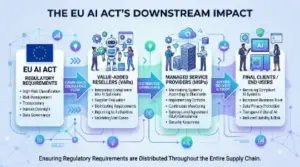
The EU AI Act classifies AI systems based on risk tiers and places strict obligations on “providers” (developers/vendors) and “deployers” (end-users or integrators). Crucially, Article 25 of the EU AI Act establishes that a distributor, VAR, or MSP will be considered a provider—inheriting all statutory provider obligations—if they:
- Put their name or trademark on a high-risk AI system;
- Make a substantial modification to an AI system already placed on the market; or
- Change the intended purpose of an AI system such that it becomes classified as high-risk.
When an MSP fine-tunes an AI model, integrates proprietary client data pipelines, or repackages an algorithmic tool for a vertical industry (such as healthcare or finance), they risk triggering provider-level statutory liability. If the underlying agreement lacks strict flow-down provisions, the original vendor can be dragged into regulatory enforcement proceedings due to unauthorized downstream modifications.
2. ISO/IEC 42001 as the Evidentiary Baseline
While the EU AI Act dictates statutory mandates, ISO/IEC 42001 serves as the global operational framework for demonstrating “state of the art” governance. Enterprise buyers in 2026 routinely mandate ISO/IEC 42001 certification as a prerequisite for RFPs. To maintain certification, vendors must demonstrate that their supplier and partner management controls (Control Domain A.10) enforce risk assessment, transparency, and data quality requirements down through third-party distribution channels.
Essential Contractual Pass-Through Mechanics for 2026
To align channel operations with regulatory realities, vendors must update their channel partner agreements to incorporate specific, enforceable pass-through covenants.
A. Scope of Use and Intended Purpose Constraints
Vendor contracts must explicitly define the “Intended Purpose” of the AI system pursuant to the EU AI Act. Downstream partners must be contractually restricted from altering systemic parameters or deploying the technology in high-risk contexts (e.g., biometric identification, credit scoring, or employment screening) without prior written authorization and joint risk assessment updates.
B. Mandatory Technical and Governance Flow-Downs
Channel partner agreements must mandate that MSPs and VARs implement and maintain operational controls aligned with ISO/IEC 42001, including:
- Data Governance Protocols: Ensuring downstream data feeds used to train or fine-tune models do not introduce bias or infringe third-party IP.
- Transparency and User Disclosures: Requiring MSPs to provide end-users with statutory transparency notices and explainability documentation required under Article 50 of the EU AI Act.
- Incident and Anomaly Reporting: Establishing strict 24-hour notification windows requiring MSPs to inform the vendor of systemic anomalies, security incidents, or suspected hallucinations that could trigger statutory reporting duties to European market surveillance authorities.
C. Audit Rights and Verification Mechanisms
Paper warranties are insufficient without verification rights. Modern VAR agreements must grant vendors the right to perform annual compliance audits—and real-time log reviews—to verify that the MSP’s deployment architecture complies with passed-through safety mandates.
Restructuring Downstream MSP and VAR Indemnification
The primary point of friction in channel negotiations is the allocation of financial responsibility for regulatory fines, private civil litigation, and mitigation costs. Standard indemnification clauses frequently fail in the AI context due to legacy carve-outs and liability caps.
1. Expanding the Scope of Downstream Indemnification
Vendors must mandate that MSPs and VARs indemnify, defend, and hold harmless the vendor against third-party claims, administrative fines, and legal expenses arising from:
- Unauthorized modifications, fine-tuning, or prompt engineering performed by or on behalf of the MSP;
- Deployment of the AI system outside the contractually agreed Intended Purpose;
- Failure of the MSP to deliver required EU AI Act transparency disclosures to end-users;
- Misconfiguration of system guardrails, safety filters, or privacy settings during client onboarding.
2. Uncapping Regulatory and Governance Liabilities
Traditional MSP contracts cap liability at the fees paid by the reseller in the preceding 12 months. Given that statutory fines under the EU AI Act can reach up to €35 million or 7% of global annual turnover (whichever is higher), standard fee caps leave vendors exposed to catastrophic loss.
Vendors should structure indemnification clauses to classify non-compliance with passed-through AI governance covenants and statutory EU AI Act obligations as an uncapped super-exception to the limitation of liability, alongside gross negligence and IP infringement.
3. Mitigating Mutual Risks Through Joint Governance
While vendors must protect their financial position, overly aggressive terms can paralyze channel sales velocity. To achieve commercial balance, leading enterprise vendors are adopting tiered indemnification models:
| Risk Category | Allocation Strategy | Liability Structure |
|---|---|---|
| Core Algorithm Defects / Base Model Bias | Vendor Retains Responsibility | Subject to standard commercial caps; vendor indemnifies partner against core IP/algorithmic claims. |
| Partner Fine-Tuning & Integration | MSP/VAR Assumes Liability | Uncapped indemnification or elevated cap (e.g., 5x-10x contract value / dedicated AI insurance requirement). |
| Unapproved High-Risk Deployment | MSP/VAR Assumes Liability | Uncapped indemnification covering direct statutory fines and regulatory defense costs. |
External Strategic Legal References

When drafting and updating channel documentation, legal practitioners should consult primary statutory frameworks and international standards bodies:
- For comprehensive statutory text regarding provider and deployer obligations, review the official European Union AI Act (Regulation EU 2024/1689) text published in the Official Journal of the EU.
- For standard specifications on structuring an Artificial Intelligence Management System across supply chains, consult the ISO/IEC 42001 Overview Page.
- To align channel privacy pass-through provisions with European data protection jurisprudence, refer to the European Data Protection Board (EDPB) Guidelines on data processing roles.
Conclusion: Modernizing Channel Agreements for the AI Era
The transition toward strict AI accountability requires software vendors to treat channel partners as critical components of their regulatory compliance perimeter. Continuing to rely on pre-2024 reseller agreements exposes vendors to severe regulatory penalties and reputational damage driven by downstream actions beyond their direct control.
By enforcing clear ISO/IEC 42001 operational pass-through mechanics and restructuring VAR/MSP indemnification to address high-risk deployments, vendors can safely leverage indirect sales channels while insulating their core business from regulatory liabilities in 2026 and beyond.