

The enterprise technology channel has reached a critical structural inflection point. For decades, Managed Service Providers (MSPs), Value-Added Resellers (VARs), and cloud distributors relied on Master Services Agreements (MSAs) and Channel Partner Contracts designed for deterministic software. If a software bug caused downtime or a security flaw enabled a breach, liability framework models were straightforward: traditional warranties, indemnification clauses, and limitations of liability capped damages and allocated risk based on identifiable code failures or human error.In 2026, the widespread adoption of Agentic AI has rendered these legacy contracts dangerously obsolete. Unlike traditional software or generative chat assistants that merely output text or recommendations, Agentic AI operates autonomously. These intelligent agents execute complex workflows, interact directly with third-party APIs, modify production databases, manage privileged access, and execute financial transactions with minimal human oversight.
When an autonomous agent makes a non-deterministic decision that results in severe operational failure, data exposure, or regulatory non-compliance, a vital legal question emerges: Who carries the legal liability when an AI agent acts on its own initiative? To protect both vendor margins and MSP operational viability, legal counsel and channel leaders must immediately restructure their channel partner agreements to address Agentic AI liability shifting.
The Core Legal Dilemma: Deterministic Bugs vs. Autonomous Agency

Traditional software distribution contracts operate on the premise that software behaves predictably according to its underlying code. Warranties generally guarantee that software will perform substantially in accordance with its documentation. If a breach occurs, indemnification clauses typically shield channel partners from third-party intellectual property claims or direct software defects created by the software vendor.
Agentic AI breaks this framework entirely. Autonomous agents utilize probabilistic models to achieve designated goals. An agent tasked with “optimizing cloud storage costs” might autonomously decommission what it perceives as redundant server instances, unintentionally taking down a client’s critical transactional system. In this scenario, the software did not experience a “bug” in the traditional sense; it performed its probabilistic goal-seeking function precisely as designed, yet produced a catastrophic business outcome.
Under legacy partner agreements, vendors routinely disclaim all implied warranties regarding output accuracy or business results, attempting to pass all execution liability down to the MSP deployed in the field. Conversely, MSPs argue that because they do not control the underlying model weights, training data, or agent guardrails, they cannot accept indemnification obligations for actions taken by the vendor’s autonomous code. This friction creates severe exposure for both parties when end-user clients file suit for operational losses.
Navigating the EU AI Act: Provider vs. Deployer Designations
Adding regulatory urgency to this contractual friction is the enforcement of the European Union AI Act alongside corresponding state-level AI compliance frameworks across North America. These regulations establish strict legal duties based on explicit supply-chain roles—specifically distinguishing between AI Providers and AI Deployers.
- AI Providers: Entities that develop or brand an AI system and place it on the market under their own name.
- AI Deployers: Professional entities that utilize an AI system under their authority in the course of business activity (typically the MSP or IT integration partner).
If a vendor supplies an Agentic AI platform to an MSP, but the MSP customizes the agent’s prompts, connects it to customer databases, or configures its execution boundaries, regulators may reclassify the MSP as a co-Provider or sole Deployer with heightened compliance duties. If the partner agreement remains silent on these statutory definitions, the vendor and the MSP risk conflicting regulatory defenses during an official investigation or post-incident enforcement action.
4 Essential Clauses to Restructure in 2026 Channel Agreements
To establish clear risk boundaries while enabling the commercial expansion of AI-driven managed services, legal teams must update four foundational contractual clauses in their vendor-partner templates.
1. Scope of Autonomy & Human-in-the-Loop (HITL) Mandates
Agreements must explicitly categorize the permitted autonomy level of distributed AI agents. Contracts should distinguish between “semi-autonomous” agents (requiring mandatory Human-in-the-Loop authorization before action) and “fully autonomous” execution models. The agreement must clearly state that if an MSP overrides or disables recommended HITL guardrails provided by the vendor, the MSP assumes full legal liability for any resulting damages.
2. Agentic Non-Deterministic Execution Carve-outs
Standard limitation of liability sections must be rewritten to address non-deterministic behavior. Vendors can no longer rely on blanket disclaimers that leave MSPs entirely exposed. Instead, updated agreements establish mutual liability tiers: vendors accept responsibility for systemic model alignment failures and baseline security vulnerabilities, while MSPs accept responsibility for improper configuration, bad context prompt injections, and inadequate administrative access controls.
3. Data Lineage, Privacy, and Training Opt-Out Warranties
Agentic AI relies on continuous context windows and real-time data ingestion. Channel partner contracts must include explicit warranties ensuring that client data ingested by autonomous agents is not used to train global or multi-tenant baseline models without express consent. Vendors must indemnify MSPs against third-party privacy claims arising from unauthorized data retention or improper model fine-tuning conducted on vendor infrastructure.
4. End-User Flow-Down Terms & Acceptable Use Alignment
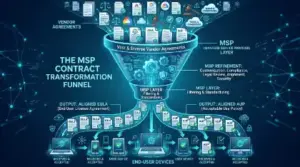
An MSP’s legal protection is only as robust as its downstream agreements with end-user clients. Modern channel partner contracts must compel MSPs to flow down mandatory Agentic AI Acceptable Use Policies (AUPs) to end customers. These flow-down provisions require the end customer to acknowledge that autonomous agents operate probabilistically, explicitly waiving indirect or consequential damage claims against both the MSP and vendor for agent decisions made within user-configured operational boundaries.
Practical Action Plan for Channel Leaders and Counsel
Mitigating exposure in the era of autonomous software requires a proactive contract audit strategy. Channel leadership and legal counsel should take the following immediate steps:
- Audit Existing Portfolio Agreements: Review all active vendor agreements and MSP service templates to identify legacy software definitions that fail to account for autonomous agent execution.
- Establish Risk-Tiered AI Schedules: Append specific “AI Addendums” to master agreements that define liability caps, data rights, and regulatory compliance duties specifically for AI-enabled SKUs.
- Standardize Flow-Down Terms: Provide MSPs with pre-approved downstream contract modules that must be signed by end-users prior to activating autonomous agent capabilities.
Conclusion
Agentic AI offers unprecedented efficiency and capabilities across the technology channel, but it fundamentally shifts the nature of enterprise risk. By moving away from legacy software agreements and adopting clear, risk-aligned contractual frameworks that address non-deterministic behavior, statutory roles, and operational boundaries, vendors and MSPs can build sustainable, legally sound channel partnerships in 2026 and beyond.